What Is Livewire+ AES67?
Livewire+ AES67 is the second-generation of Livewire, the pioneering technology invented by the Telos Alliance to convey low-delay, high-reliability audio over switched Ethernet.
Introduced as Livewire™ in 2003, today’s Livewire+ AES67 is, like its name implies, completely AES67-compliant. That means that it complies fully with the AES67-2015 Interoperability Standard, allowing AES67 devices to connect directly to Livewire+ AES67 networks and exchange audio streams. Livewire+ AES67 is also extensible, able to incorporate future AES standards when they are ratified. It's also backward-compatible with the RAVENNA™ networking protocol.
With Livewire+ AES67, a single Ethernet cable carries real-time uncompressed digital audio, device control messages, program associated data, and even routine network traffic. An entire facility can be wired in hours, instead of weeks. Many Axia Audio studio products, along with other products from Telos Alliance brands, utilize Livewire+ AES67 networking technology. Expanding or modifying your system is simple thanks to the inherent scalability and modularity of Livewire+ AES67.
Livewire+ AES67offers a revolutionary change in how studios can be built. But at the same time, it's a natural continuation of general trends and what you already know.
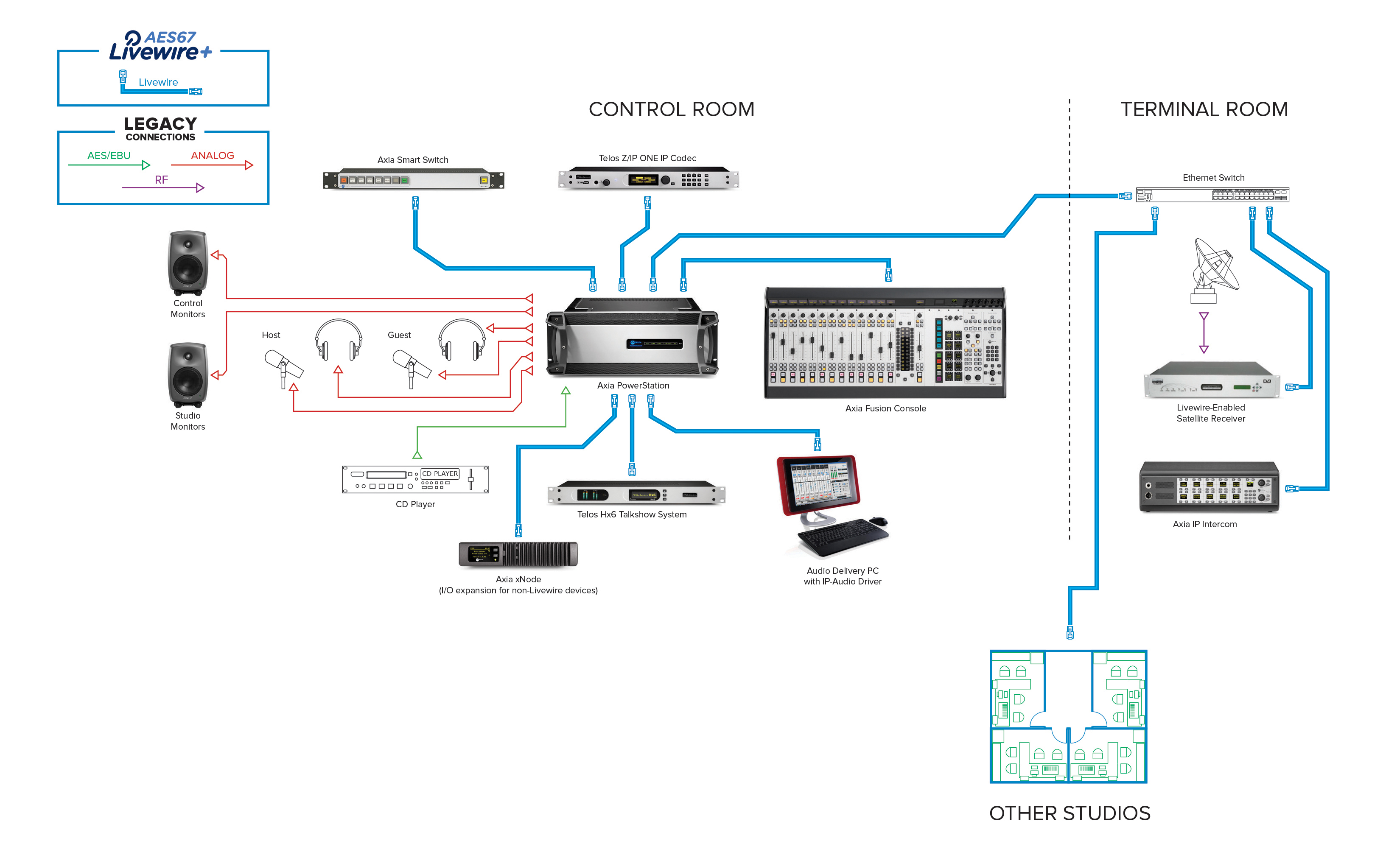
All-Livewire Studio
The advantage of an all-Livewire system is full support of advertising/discovery, GPIO, and Program Associated Data throughout every link in the system.
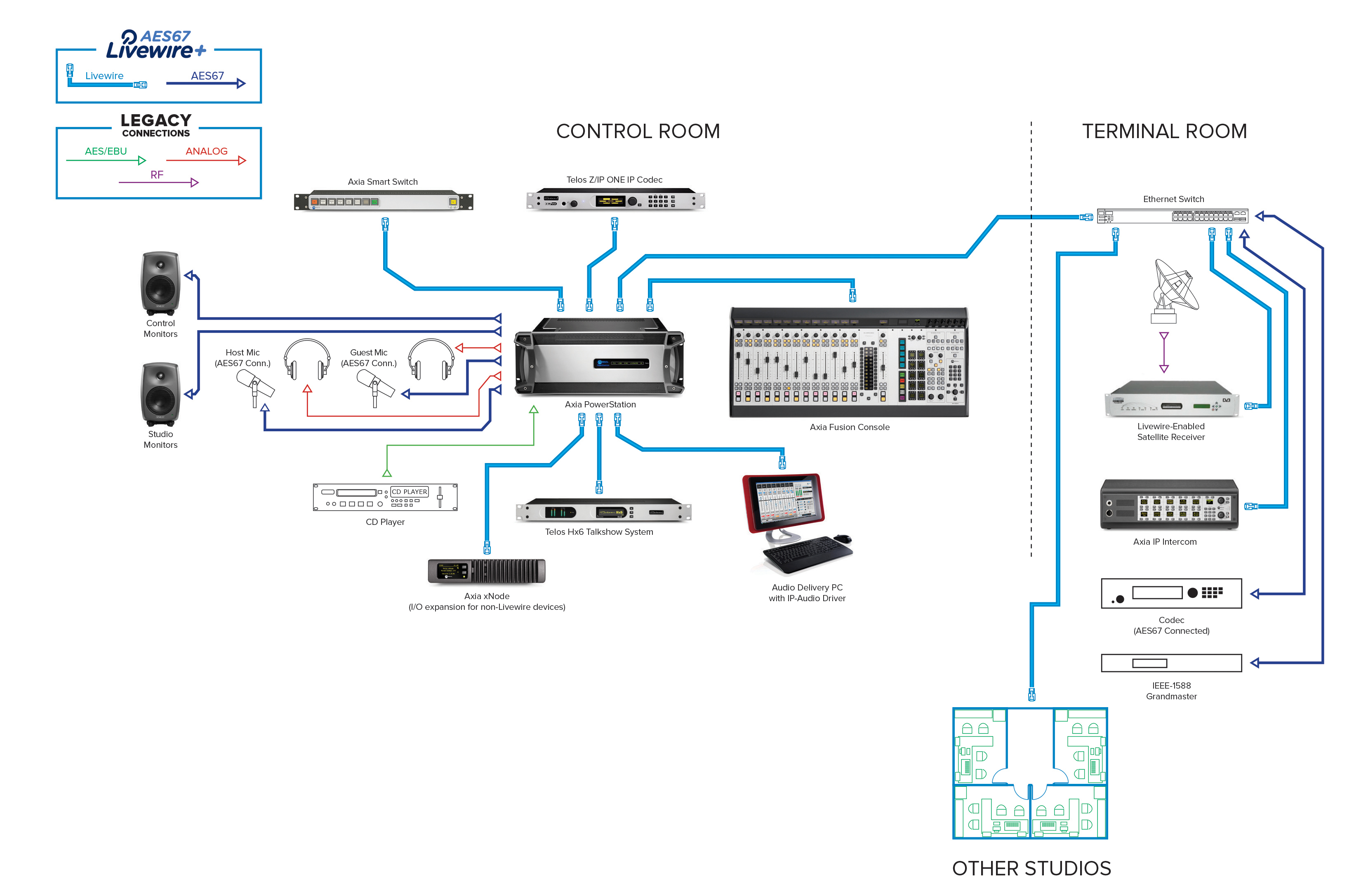 Livewire+ AES67 Studio
Here, the microphones, speakers, and codecs are interconnected using AES67 instead of Livewire. While these devices can coexist within the Livewire system, with only an AES67 connection, they do not have the ability to support advertising/discovery, GPIO, and Program Associated Data (PAD) as Livewire does today.
How Livewire+ AES67 Works
Livewire+ AES67 has an audio advertising system. Every source has a text name and numeric ID. These are transmitted from source devices to the network. Devices that play audio build lists of all available sources from which users can select. Using Telos Alliance xNode audio interfaces, you enter the names of your input sources via any PC with a web browser. With playout PCs running the Axia AoIP Driver, you open a configuration window.
A sophisticated phase-locked loop clocking system allows Livewire+ AES67 to use very small buffers for least latency and ensures that audio channels remain time-aligned (as needed for multiple mics in a studio or for TV surround-sound mixing.) Livewire+ AES67 networks employ two types of audio streams. Livestreams have small, frequent packets optimized for live audio that requires very low (circa1 ms.) delay, for microphones and headphone audio. Standard Streams are also real-time streams, but with bigger packets, and are used for audio streams which don't require super-low latency—like audio from CD players, or that exchanged with automation system PCs. Devices that connect to Axia networks can transmit and receive both stream types; the user selects which type to generate when a device is initially configured.
Converged Networks
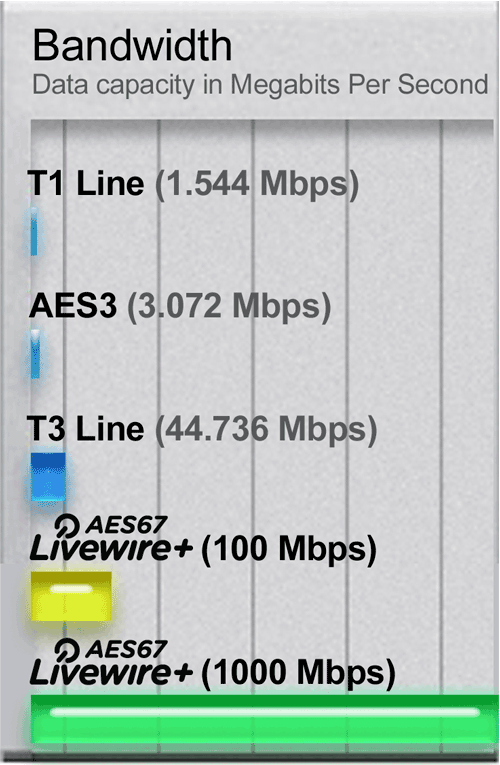
An Ethernet network used for Livewire+ AES67 audio can also be shared with other data transmissions, such as file transfers and web browsing. An Ethernet system with a switch at the center may have a mix of audio nodes and normal servers, PCs, etc., because the Ethernet switch directs traffic only to where it is needed.
Even on a single link, traffic can be mixed because we use modern Ethernet's priority mechanism to be sure audio packets have first call on the link's bandwidth. A studio audio delivery system can use this capability to download an audio file from a server, for example, while simultaneously playing another audio file live.
Livewire+ AES67 maximizes the benefits of converged networking in the broadcast facility. Many stations using Livewire+ AES67 have computer data, telephone, audio, and control on a single network that uses computer industry standard wiring, spurring cost-efficiencies throughout the plant.
Audio Quality
A Livewire+ AES67 network is a controlled, high-speed environment, with no risk of audio drop-outs from network problems and plenty of bandwidth for many channels of high-quality uncompressed audio. We use studio-grade 48kHz/24-bit PCM encoding. Telos Alliance digital xNode audio adapters deliver 138dB of dynamic range, with less than 0.0002% THD. Even analog xNodes have 100dB dynamic range, < 0.005% THD, and headroom to +24dBu.
Livewire+ AES67 Is Standards-Based
Since the very beginning, the Telos Alliance has based its AoIP networking technologies on standards. IP (Internet Protocol), the networking standard that is the underpinning of nearly all critical business networks (and of the Internet itself) is the basis for Livewire+ AES67 AoIP.
As charter members of the AES X.192 Working Group, we helped define the AES67 standard—and became the first broadcast manufacturer to become AES67-compliant.
Livewire+ AES67 is so standards-based, in fact, that your audio can even be played by PC media players that support standard protocols and uncompressed PCM audio. The Internet’s IP standard for streaming media, called RTP/IP, is used for standard audio streams. RTP stands for Real-Time Protocol. It's the Internet’s standard way to transport streaming audio and video, just as TCP/IP is the standard for general data.
Continuing the Gold Standard
In the 14 years since the introduction of the original Livewire, broadcasters have adopted it at an exponential rate; AoIP has become the new standard for broadcast facilities, with more than 8,000 studios worldwide, 100+ Livewire partners, and 100,000 Livewire devices in the field.
Impressive, no? But there are even more exciting things in the future. The Telos Alliance, with one of the largest R&D groups in broadcast, is fully committed to AoIP interoperability. We’ve been proponents of open standards since Day 1, freely sharing our technology with interested Hardware and Software Partners. We were charter, supporting member of the X.192 Working Group that defined the AES67 standard, and as founding members of the Media Networking Allliance, are actively engaged in work to promote and enhance standards-based AoIP networking.
AES67 Resource Center
Here are some resources to help answer your questions about the history and specifics of Livewire, AES67, and more.
-
AoIP / AES67 Abstract - AoIP / AES67 Abstract from Telos Alliance Chief Science Officer Greg Shay.
-
Greg Shay talks AES67 on TWiRT - Telos Alliance Chief Science Officer Greg Shay visits This Week in Radio Tech to discuss the newly-minted AES67 (formerly X192) standard in September 2013.
-
Audio over IP Interoperability: Made Possible by The Telos Alliance - A brief review of the significant role of The Telos Alliance played in the development of the AES67 interoperability standard.
-
xNodes for AoIP: What You Don’t Know Could Thrill You - Axia Audio's xNodes speak AES67, and more. Learn about the features and technology behind xNodes - the first audio interface to support a connection protocol besides our own.
-
What's the Deal with AES67? - Marty Sacks provides some background on the AES67 standard for Audio over IP.
-
AoIP: It’s the ecosystem, not just the technology - Marty Sacks and Kirk Harnack describe benefits of the AoIP ecocsystem.
-
Telos Alliance Leads the Way on AES67 - Telos Alliance Chief Science Officer Greg Shay provides a look at the development of Livewire AoIP, and our role in the history of the AES67 standard.
You probably know that the Telos Alliance has been involved in designing the architecture of AoIP interoperability since the very beginning (even when some folks claimed it wouldn’t even work!).
First, we promoted interoperability using the standard IP networking technologies built into Livewire, beginning in 2003. Then we became sustaining members of the X.192 project committee, which wrote the AES67 standard ratified by the AESSC in September, 2013. By December 2013, we had already implemented AES67 in our Telos Alliance xNode audio interfaces.
But we didn’t just stop there. We’ve continued to fully integrate AES67 into Livewire+ AES67, in order to give Axia clients the best possible experience. Not only that: we’ve structured Livewire+ AES67 so that it can be extended to comply with future standards.
As part of the X.192 working group, Axia and the Telos Alliance worked with other companies to help define the AES67 standard. During this process, we made available, at no charge, parts of our own patented technology to help speed development of the standard. Much of Livewire+ AES67 is the basis for AES67. You might say that AES67 has Livewire+ in its DNA.
So what does the “plus” in Livewire+ AES67 mean, exactly?
It means three things.
-
Livewire+ AES67 is completely AES67-compliant. Compliant means that it fully complies with all parts of the AES67 standard.
-
Livewire+ AES67 is future-proof, because it’s extensible. Future standards can be included once ratified; so Livewire+ AES67 can never become obsolete.
-
Choosing Livewire+ AES67 means you don’t have to wait for interoperability. Livewire and Livewire+ represent the world’s largest grouping of AoIP technology partners – more than 100 software and hardware manufacturers and integrators whose products work together, with integrated audio, source discovery, logic control and data — right now, without the need to wait for additional standards.
It means three things.
-
Livewire+ AES67 is completely AES67-compliant. Compliant means that it fully complies with all parts of the AES67 standard.
-
Livewire+ AES67 is future-proof, because it’s extensible. Future standards can be included once ratified; so Livewire+ AES67 can never become obsolete.
-
Choosing Livewire+ AES67 means you don’t have to wait for interoperability. Livewire and Livewire+ represent the world’s largest grouping of AoIP technology partners – more than 100 software and hardware manufacturers and integrators whose products work together, with integrated audio, source discovery, logic control and data — right now, without the need to wait for additional standards.
The difference is subtle, but important — compliant is not the same as compatible! “Compliant” means that Livewire+ AES67 fully complies with all parts of the AES67 standard. It’s baked-in, if you will.
“Compatible”, on the other hand, means that someone’s proprietary tech can co-exist with the AES67 standard. In essence, compatibility is like two different people sharing one body: the proprietary tech is patched with add-on code to get by, but doesn’t fully comply with all aspects of the standard.
According to Mark Yonge, AES Standards Manager:
“This standard defines an interoperability mode for transport of high-performance audio over networks based on the Internet Protocol. For the purposes of the standard, high-performance audio refers to audio with full bandwidth and low noise. These requirements imply linear PCM coding with a sampling frequency of 44,1 kHz and higher and resolution of 16 bits and higher. High performance also implies a low-latency capability compatible with live sound applications. The standard considers latency performance of 10 milliseconds or less. This standard provides comprehensive interoperability recommendations in the areas of synchronization, media clock identification, network transport, encoding and streaming, session description and connection management.”
(Reference: http://www.aes.org/standards/blog/2013/9/aes67-2013-audio-over-ip-130911)
The AES67 specification is a good start toward interoperability, but is actually a subset of the many functions that Livewire+ AES67 performs today. When we developed Livewire back in the early 2000s, we had to synthesize the critical links between networking technologies, because a full standard didn't exist yet — and earlier networked audio systems lacked critical functionality. We developed a way to make GPIO logic “ride along” with the audio streams, and a way for available sources to “advertise” their availability to all the networked devices that operators might want to use.
We also recruited partner companies whose products are respected and widely used in the radio industry. Then we shared our technology with them, so that station engineers could connect as many audio devices as possible directly to their audio network. Not only is native connectivity an elegant solution, it reduces total system costs by removing the need for those extra I/O devices.
Ten years later, the industry finally adopted a standard for AoIP audio transport in AES67. The goal is for every studio audio device to eventually click together with CAT-5 and share audio. But along with that shared audio, there’s a whole world of other functionality that broadcasters expect — like device start/stop functions, monitor mutes, on-air tallies, the ability to control peripherals from the console, the ability to know when an audio source is live and ready for air, the ability for playout systems to control fader on/off functions and more. Those are functions that AES67 alone doesn’t provide for, but Livewire+ AES67 does. With more and more AES67 devices in the market, broadcasters have quickly found that they also need to support those additional capabilities in order to provide an integrated control experience for the user — otherwise they’re no better than AES3 streams, with serial GPI cables running alongside. With Livewire+ AES67, you can have your cake and eat it too.
Yes. Axia and RAVENNA have been partners for several years, both working together to define the AES67 standard. Standards-based Livewire+ AES67 is also backward-compatible with the RAVENNA protocol.
You say that Axia introduced AoIP to broadcast in 2003, and you’ve got 8,000 Livewire studios on-air. Why is AES67 even needed?
When Steve Church, Greg Shay and their team were developing Livewire, they had to invent tech that didn’t exist before. One critical piece of tech was network clock sync. Problem was, the Ethernet standard in place at the time had no criteria for high-precision time-synched audio.
Why is this so critical? As Telos Alliance Chief Science Officer Greg Shay explained in his excellent paper “Taking the ‘Sting’ Out of Evolving Digital Audio Networks” (presented at NAB 2013): “Accurate timebase recovery is directly related to, and essential for, low latency (low delay) of the audio going over the network.”
In other words, if you want networked, real-time, broadcast quality audio without jitter and delay, you’ve got to have all network devices synchronized to a network master clock. So we invented the first distributed high-precision clocking system for Ethernet, and debuted it in Livewire.
Although we have always been happy to share our tech with software and hardware manufacturers, other, open methods of Ethernet clock sync emerged, one of which became the IEEE-1588 synchronization standard — which is an integral part of AES67.
Not unless you’re prepared to wait quite a while. Implementing a new standard always takes time, as manufacturers adapt existing products, design new ones, and release software updates.
In the meantime, Livewire+ AES67 is working today, and has a roadmap for future compatibility of existing hardware. This assurance means that the studio you build with Livewire+ AES67 today will be compatible with future AES standards for AoIP — your studio gear can’t become obsolete.
Compliance with AES67 is a part of the latest software present in Telos Alliance analog, AES/EBU, microphone and mixed-signal xNode AoIP interfaces, and SDI xNode devices. If you have these products already, simply download the update packages and apply them using a standard Web browser and PC, or use Axia iProbe software to “push” the update to your devices en masse. After this update, you’ll be able to generate and consume native AES67 streams.
No! Livewire+ AES67 and AES67 coexist on the same switch fabric.
The whole idea of AES67 is to open up more equipment choices when you buy. The AES67 standard enables equipment from a variety of manufacturers to exchange “agnostic” audio streams without fuss. However, the AES67 specification provides interoperability standards for audio only — not for control or data exchange. Nor does AES67 equipment have the ability to automatically discover available audio, and present it to the operator for use. Most engineers agree that these abilities are a big part of the AoIP advantage. So, if control and source advertising is important to you, choosing equipment with Livewire+ AES67 capability will definitely be to your advantage.